
Podcast: Play in new window | Download
Title: 3 Myths & Facts About the Holy Spirit
Text: Acts 2:1–21
Liturgical Date: Pentecost (A)
Calendar Date: May 24, 2026
Location: Saint Peter’s Lutheran Church in Door County, 316 W. Main St., Forestville, WI 54213; 920-856-6420.
Preacher: Rev. Christopher Jackson
Saint Peter’s Lutheran Church serves Luxemburg, Wisconsin, and other areas in Northeast Wisconsin.
Transcript
In the name of the Father, and of the Son, and of the Holy Spirit. Amen.
And they were all filled with the Holy Spirit and began to speak in other tongues as the Spirit gave them utterance.
And on this great and holy day of Pentecost, we’re going to be taking up the theme of the gift of the Holy Spirit.
The Gift of the Holy Spirit
A choice of words is deliberate, the gift of the Holy Spirit. ‘Cause indeed the Holy Spirit is a wondrous gift that the Lord grants His people. By the Holy Spirit, He grants miracles, the greatest miracle being the miracle of the transformation of the heart. By the Holy Spirit, He opens our minds to hear the Word of God and to understand it as He’s given to us in the Holy Scriptures, and He continues to extend it to us as well in the Holy Sacraments, and that’s at the core of what our sermon is today.
We’re going to be talking about various myths about the Holy Spirit, three myths about the Holy Spirit, and three facts about the Holy Spirit in contradiction to these three myths.
Two Images of Pentecost
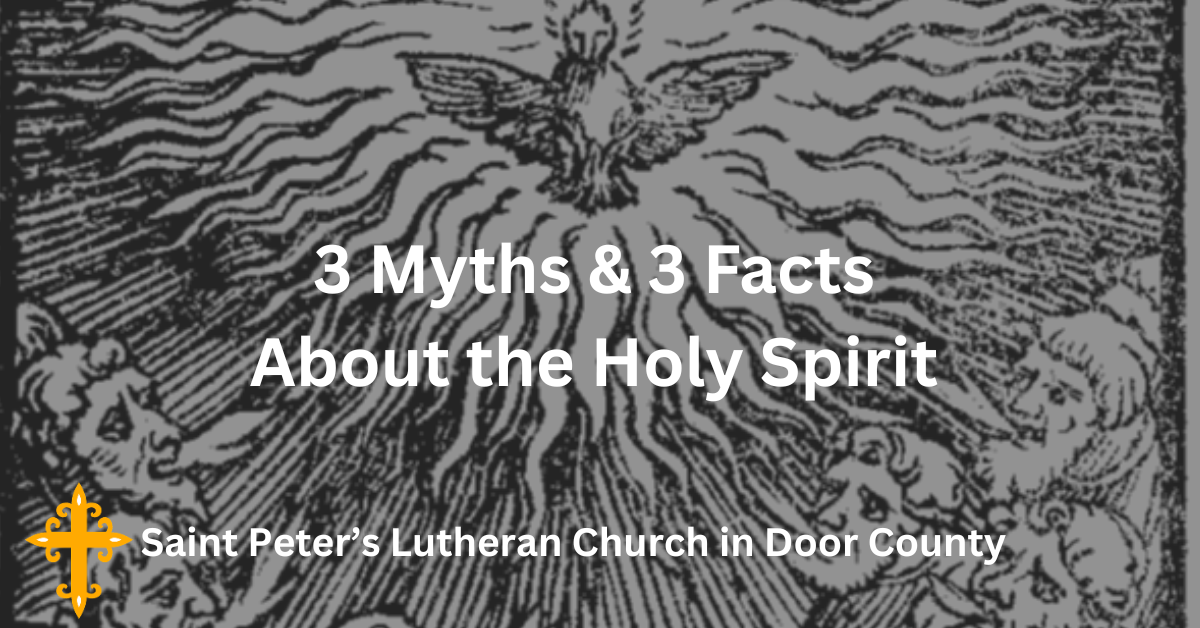
Now, to help begin to illustrate this a little bit, I’d actually like for you to take a look at these two images right here.
So most Sundays we use the pre-printed bulletins that we get from our publishing house, and generally I like them, generally they’re great, but they’re almost universally terrible on Pentecost. Almost universally. I’ve seen multiple versions of… I’ve been doing this long enough, you see when they start to recycle them after a few years and there’s a few versions and they all kinda portray something like this.
On special feast days when we’re doing things like processions and chanting the psalm, we’ll put down the full bulletin and I’ll put another image on there. So there you go. That’s the image that Pastor Chris chose. That might look strange to you, but that’s actually an image from one of the very first editions of the Martin Luther Bible.
So one of the first Bibles printed in the vernacular language, the German language. So this was an early Lutheran image of Pentecost. Now let’s take a look at some of the differences here, ’cause it’s gonna help to illustrate some of the myths and the facts that we’re gonna be talking about with regards to the Holy Spirit.
So the biggest difference you might see is, one’s color, one’s black and white. That’s just the nature of the technology, the printing technology that was available in their times, but there’s other differences, right? Now take a look at first of all, where the fire is. Now the Greek is ambiguous about where the fire was upon their heads.
There is a Greek word for directly on top of. That’s not the word that was used. It’s an ambiguous term. Where upon the heads, it’s up for artistic interpretation. The ones who made the color one here, they interpreted on top of the heads. In our mind’s eye, that’s probably the way we usually see it, but it could have been upon their lips.
And why did the artist choose that? To indicate the truth, that the giving of the Holy Spirit was the gift to understand the scriptures, to understand what they had witnessed in Christ, and to therefore then preach it. So quite literally, they have tongues of fire. I love that, right?
What else do we see here? Okay. The disciples, the apostles that are receiving the tongues of fire upon their head they are amazed at this. They are having an ecstatic experience about this, and the people who are witnessing it are also having ecstatic experience and are filled with wonder over as well these tongues of fire coming on their heads.
None of that’s in the Bible. None of that is in the Bible, right? It doesn’t say the disciples were filled with awe and wonder over these tongues of fire that came upon them. It says after these tongues of fire came upon them, they preached. And the people were not filled with awe and wonder over these tongues of fire coming upon them, but instead they were filled with awe and wonder over their preaching, right?
Very big difference. And so I like how in this one, instead of this awe and wonder, instead they just have gratitude and reverence to God for this wonderful gift. And that’s my hope for you today. That’s the point of this sermon, is that you in turn would have gratitude towards God for the gift of the Holy Spirit.
Myth 1: Miraculous Signs and Wonders
Because the plain fact of the matter is that in American religion, we have made the Holy Spirit into a club to beat people over the head with instead of a gift to be received with gratitude and a gift which empowers us to give as well towards others. That’s at the center of our sermon.
How does American religion turn the Holy Spirit into a club to beat others over the head with? The first is by claiming that the Holy Spirit and the gift of the Holy Spirit is primarily about miraculous signs and wonders. So signs and wonders that are visible, that are, that are– cause awe and so on and so forth. This is very often associated, for example, with the Pentecostal movement.
Now, we do have a few Pentecostal churches in the area here. Back when I served in the South and lived in Missouri, this was a much bigger phenomenon than it is here, but it– we can still find influence of this idea here. And the Pentecostal movement will often say that their– your salvation, if you are truly saved, that’s going to be accompanied by various signs and wonders.
So things like speaking in a tongue. Maybe it’s a tongue that doesn’t even exist on earth, but rather is a tongue– what they might call a tongue of angels some sort of mysterious spiritual tongue, or maybe doing a work of healing or predicting the future or something like this. They’ll say these are the kinds of miraculous signs and wonders that you will show if you are saved.
And people will say things like, “Oh, they don’t actually teach, they don’t actually preach that,” but I can tell you that they in fact do. I’ve used this story multiple times. You’ve heard it before about how when I was in high school, a friend of mine, I was driving down the road with her and she said, “Chris, I believe that Jesus is the Son of God.
I believe that He died for my sins. I believe in Father, Son, and Holy Spirit, but I’m not saved and don’t think I’m going to heaven.” And I asked her why is that?” She said I’ve been going to this church and they’ve been telling me if I’m truly saved, then I’m going to be able to do something like speak in a tongue or to do a miraculous act of healing or to prophesy about the future and so on.”
And I told her, “Look, the Bible doesn’t say that. The Bible clearly teaches that, God so loved the world that He gave His only begotten Son so that whoever believes in Him should not perish but have eternal life,” right? If you believe that Jesus died for your sins, I believe you’re going to heaven.
You should have seen the weight fall off her shoulders. You should have seen the joy on her face. That’s just one way that people turn the Holy Spirit into a club, a demand rather than a gift.
The Greater Gifts: Faith, Hope, and Love
And this turning the Holy Spirit into a demand rather than a gift, a lot of times this is out of an effort to build oneself up and one’s status at the expense of others. St. Paul addressed this in the book of Corinthians. There, there was a number of people in the Corinthian congregation who were claiming that they had a special miraculous spiritual gift like the ones that we’ve been just talking about. And St. Paul doesn’t deny that they might have this, but he points to even bigger gifts and better gifts that every Christian will have as a gift of the Holy Spirit.
“Concerning spiritual gifts, brothers, I do not want you to be uninformed. You know that when you were pagans, you were led astray to mute idols, however you were led. Therefore, I want you to understand that no one speaking in the Spirit of God ever says, ‘Jesus is accursed.'” Now, here’s a linchpin in his argument here.
“And no one can say, ‘Jesus is Lord,’ except in the Holy Spirit.” Part of what St. Paul was saying here is, look, you may have some sort of miraculous gift, and if you do, praise the Lord for that, but each and every one of your brothers and sisters in Christ who have confessed Jesus as Lord is no less spiritual than you.
That is a gift of the Holy Spirit. And he goes on to talk about this. He goes on and addresses some of these various spiritual gifts, but at the end of chapter 12, he says this: “Are all apostles? Are all prophets? Are all teachers? Do all work miracles? Do all possess gifts of healing? Do all speak with tongues? Do all interpret?” And then he says, listen to this, “But earnestly desire the higher gifts And I will show you a still more excellent way.”
And then he goes on to that classic wedding text that we read at weddings, 1 Corinthians chapter 13, right? And that’s a good text to read at weddings, but a lot of times we miss the context of this. Paul is not so much talking about romantic love in 1 Corinthians chapter 13 as he is talking about the miracle of the transformation of our hearts to beat with love for God and to beat with love for the neighbor.
He goes, “If I speak in tongues of men and of angels, but have not love, I am a noisy gong or a clanging cymbal. And if I have prophetic powers and understand all mysteries and all knowledge, and if I have all faith so as to remove mountains, but have not love, I am nothing. If I give away all I have, if I deliver up my body to be burned, but have not love, I gain nothing.” Then he goes on, “Love is patient, love is kind. Love does not envy or boast,” and so on.
And finally, he ends with these words, “So now faith, hope, and love abide these three. The greatest of these is love. Even while all these other miraculous signs and wonders are going to pass away, faith, hope, and love are the greatest gifts of the Holy Spirit. And it’s those gifts, and especially love, which will endure until the end.”
The Greatest Miracle: A Transformed Heart
Now, I don’t want you to get me wrong about what I’m saying here. I’m not saying that I don’t believe in miracles. I do believe in miracles, and I’m not saying that the Holy Spirit doesn’t work miracles. I believe the Holy Spirit works miracles. What I am saying is this, is that too often we are blind to the greatest miracle that the Holy Spirit works, and that’s the miracle of the transformation of our hearts.
Apart from the work of the Holy Spirit, we are spiritually dead and blind, unable to come to the Lord Jesus Christ, unable to trust in Him, but rather, according to the book of Romans, our sinful minds are enmity against God, which means that they are hostile to God. We don’t want anything to do with God. If we hear God walking in the garden, we, like Adam and Eve, we run away.
That’s the nature of our hearts according to the original sin that we have inherited. And the miracle of God is this, is that by the Holy Ghost the Holy Spirit transforms these cold, dead hearts into hearts that beat with love. Love of God. Love of the neighbor. And that is a miracle above all miracles. And a gift above gifts of the Holy Spirit. Praise be to God for this.
Don’t doubt. Rather trust that through the gospel, the Lord works this gift to you.
Myth 2: The Holy Spirit Is About Ecstatic Experience
Which brings us to our next point, that the Holy Spirit is primarily concerned about ecstatic experience. And in contrast to this, we’re going to talk about how the Holy Spirit is about the proclamation of the Word of God.
If there is an overriding and overarching viewpoint about the work of the Holy Spirit in American Christianity, it’s this: that the Holy Spirit is found, experienced in ecstatic experience. This is the overarching principle, by the way, which drives so many viewpoints about what proper worship of God is. It’s about trying to, to elicit this sort of ecstatic experience.
And as I was thinking about this sermon, I was a little bit confused. I was sitting there thinking, “Where in the world this– did this idea come from?” That the Holy Spirit and the experience of the Holy Spirit is through ecstatic experience, because I can understand where the Pentecostals are coming from. Even though I don’t necessarily agree with it, I can understand where they’re coming from because, it has this scriptural basis. But there is literally nowhere in the Bible which attaches an ecstatic experience with the presence of the Holy Spirit.
You can’t find it anywhere. It’s nowhere. Why is it that, that this came to be? As I started to think about this, I realized, you know what? This is just the outgrowth of the viewpoint, the cultural air of the 1960s and ’70s and how that kinda changed American culture and the way that we understand things and so on and so forth.
And I think this is, I think this is actually very a firm attachment here. In fact, I would go even further, and if you look into some of the commitments of the 1960s and ’70s which led to this idea, you really don’t get very far until you start running into Eastern religions. I’m not joking. Think about John Lennon, for example, right?
The man at the forefront of the cultural transformation of the ’60s and ’70s and influenced by Eastern religions. The Jesus people movement of the ’60s and ’70s as well. Many of those people came out of Hare Krishna. I think this is on firm ground. So I’m not gonna say you have to believe that. I’m not saying that’s the word of God. This is my theory because I can’t figure out where this idea came from otherwise.
And once again, this is a club that is used upon the people of God. And it’s a much more sly club. It’s a little bit more subtle. The idea is this if you don’t have this sort of ecstatic experience, then maybe you are not a child of God.
You might say, “Pastor Chris, you’re exaggerating.” No. This is my– I’ve experienced this. I know this. I’ve experienced this in my own personal experience. I’ve experienced this with couples that I’ve counseled where, a couple they have engaged in this sort of worship mentality and one will say, I’m embarrassed of my fiancé because he doesn’t have that kind of experience, and I’m not sure if he’s really a Christian.”
I’ve had people say this to me.
Brothers and sisters in Christ, the Holy Spirit is not about ecstatic experience. It is about the Word of God. What happened when the apostles were filled with the Holy Spirit? They preached the Word of God. By that preaching of the Word of God, people believed the Word of God and believed in the Word of God, who is Christ Jesus.
Myth 3: Direct Access to God Apart from Scripture
This brings us to our final point, the final myth. The Holy Spirit is about direct access to the mind of God apart from the Word of God.
Going back about, I don’t know, 15, 16 years ago or so, I was sitting listening to a sermon and the preacher said, “I know the Bible says this and this thing. I know the Bible says that, but I say this, and I can say this because I have the Holy Spirit.”
And I’ve heard variations of this all over. You, if you really start listening, you’ll hear people saying things like this, “Yeah, the Bible says that, but the Holy Spirit now is saying this, for I have the Holy Spirit, and so therefore I am saying this.”
I want you to listen. John 14:26. There, Christ Jesus says this: These things I have spoken to you while I am still with you. But the Helper, the Holy Spirit, whom the Father will send in my name, he will teach you all things and bring to your remembrance all that I have said to you. Peace I leave with you, my peace I give to you. Not as the world gives do I give to you. Let not your hearts be troubled, neither let them be afraid.
Christ Jesus was saying that the work of the Holy Spirit is not to reveal anything beyond what was already revealed in Him, who is the very Word of God, the very picture of God Himself. There is nothing more to be revealed than has been revealed in Christ Jesus and the scriptures which testify to it. It’s the fullness of God’s revelation.
And the work of the Holy Spirit is to help us to better understand and to better take to heart the teaching of the Word of God. Above all this, that through Christ Jesus, all our sins are atoned for and all unrighteousness fulfilled, so that for us is not judgment, but rather justification. For us it is not condemnation, but rather glorification. For us it’s not eternal death, but rather for us is eternal life.
That is the gospel message that the Holy Spirit uses to transform our hearts and the Holy Spirit in turn helps us to believe that message and causes us to believe that message.
And once again, people use the Holy Spirit. If they say that the Holy Spirit is about them having direct access to the mind of God, this is something that they use for external force and compulsion. They want to put themselves in authority over you. Rather than acknowledging the authority of the Word of God.
The True Gift of the Holy Spirit
And through this message, my hope for you is this, that as Christ said that through the Holy Spirit, we would have peace, and that we would have freedom from fear, that our hearts instead of being troubled instead would be glad and full of faith and full of love.
My brothers and sisters in Christ, all praise be to God for the gift of the Holy Spirit. You can be confident that wherever the Word of God is rightly preached, wherever the sacraments are given in accordance with the institution of Christ, the Holy Spirit is there doing His work to transform our hearts into hearts that beat with faith, hope, and love.
In the name of the Father, and of the Son, and of the Holy Spirit. Amen.