
Podcast: Play in new window | Download
Title: Glad Confession
Text: Gospel: Matthew 10:5a, 21–33
Liturgical Date: Pentecost 4, Proper 7 A
Calendar Date: June 21, 2026
Location: Saint Peter’s Lutheran Church in Door County
Preacher: Rev. Dr. Christopher D. Jackson
St. Peter’s serves Sturgeon Bay and other areas in Northeast Wisconsin.
Transcript
Introduction: A Glad Confession of Christ
In the name of the Father and of the Son and of the Holy Spirit. Amen.
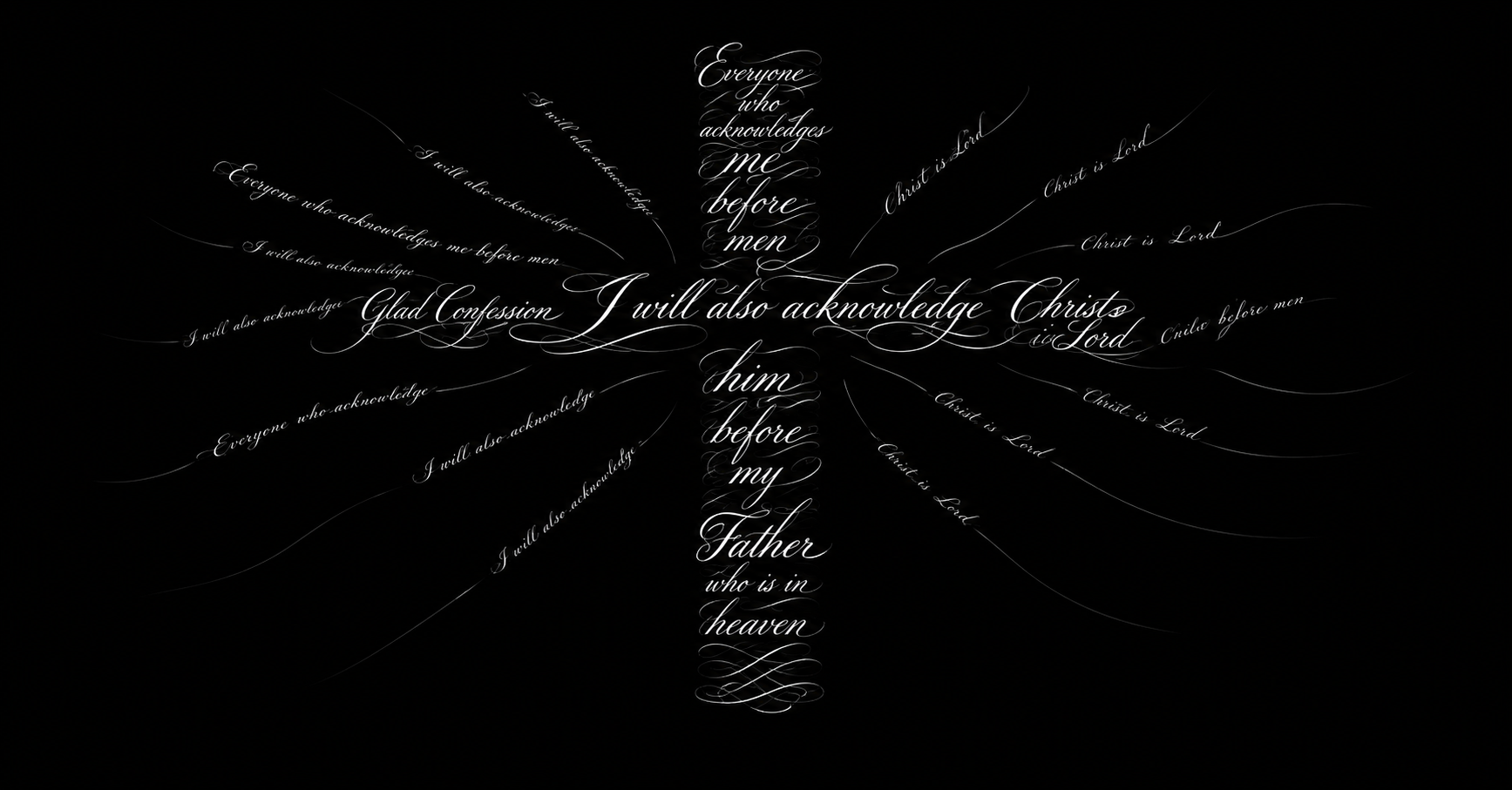
Christ our Lord said these words in our Gospel lesson for today: “Everyone who acknowledges me before men, I will also acknowledge before my Father who is in heaven. But whoever denies me before men, I will also deny before my Father who is in heaven.”
On the basis of this passage, we are going to be talking about making a glad confession of Christ Jesus, our Lord.
Father’s Day and the Power of the Tongue
Today is Father’s Day, and when we observe Father’s Day, it is hard for me not to think of that old classic country song. I love classic country music. The song is “Daddy’s Hands.” “Daddy’s hands were soft and gentle, and Daddy’s hands were hard as steel,” and so on it goes.
Certainly, when we think of fathers, we might think of hands, right? The hands that provide, the hands that protect, the hands that guide, the hands that correct, and so on. There is a lot of truth to that.
But really, when it comes to fatherhood, there is another member of the body which is even more powerful than the hands. And what member of the body is that? The day is going to come — and it has already begun in my household — when these hands can’t do that guiding and correcting and protecting anymore in a physical way. The day is even going to come when these hands can’t even do any kind of providing whatsoever. In a sense, these hands will, in time, become weak. And instead, I will need protection and provision and even guidance. It is the way the world goes.
So what is going to help with that provision and protection and guidance when these hands are no longer able to? It is the tongue. When I think of fatherhood as a father, the tongue is probably the most important part of the body. I would not be a father were it not, for example, for the tongue. When, twenty-three years ago, I said, “I do,” that set me on the course of being a father. And as a father, even while these hands have been important, what has been even more important is the tongue — giving words of guidance, words of instruction, words that protect from even worse enemies than those who might assault the body: from those enemies which might assault the soul, the heart, and the mind.
Even when I am long dead and gone and in the grave, and perchance if the Lord has blessed me and prospered me, those words will continue to guide and provide and protect even while I am in the grave. Our tongue is a powerful force. It is a way of guiding our lives. It shows who we are. And on account of this, therefore, it is good for us to gladly make confession of the faith that dwells in our hearts — to gladly confess in word that Jesus Christ is Lord, the Savior from the sins that we have committed, and the one who has earned us eternal life. That is what our sermon is all about today.
What “Confession” Really Means
Now, as we talk about this and about making a glad confession, that choice of words might be a little bit confusing to you. Confession? Isn’t that when you say that you did something wrong? Yes, that is one definition of confession, absolutely. But there are other ways that term is used, and we are using it in one of these other senses. Another sense of the word confession is simply giving voice to what you believe, and that is the sense in which we are using “confession” today.
It is a very important word for our congregation here at St. Peter’s. We are what is often called a confessional Lutheran church. What does that mean? It means that we have bound ourselves to certain statements regarding the Christian faith. They are enclosed in a book called the Book of Concord. You are most familiar with the Creeds, which are part of the Book of Concord, and also with the Small Catechism, which is also in the Book of Concord. The church as a whole has dedicated itself to that. That is a confession.
And also as individuals, we are called by Christ to make glad confession about what we believe regarding Him and the work that He has accomplished for our sakes.
Life Is Led by the Tongue
One of the most important reasons why we ought to be glad to confess our faith is, first of all, that life is led by the tongue. There are many passages which indicate this. In Proverbs chapter 18, verses 20 and following, we find these words: “From the fruit of a man’s mouth his stomach is satisfied. He is satisfied by the yield of his lips. Death and life are in the power of the tongue, and those who love it will eat its fruits.”
What Solomon is telling us in the Book of Proverbs is that the tongue has a way of shaping our life, and we will receive the fruits of what we speak. We have many other passages in Scripture which indicate this. We have, for example, James, which talks about the tongue being like a rudder which guides a ship.
Now, here is not what I am saying. There is a whole bunch of talk out there, especially on social media, about “manifesting,” for example. That is not what we are talking about. We are not talking about creating reality or manipulating God just simply by what we speak. But rather, what I am saying is this: what we speak certainly does yield in our lives certain ways of being and certain results.
So for example, back in 1993, I took my confirmation vows. That was a really special day in which I confessed that I have a desire to live as a Christian my entire life, to believe as a Christian my entire life, and that has guided the choices that I have made in life. That is one example of how what we speak shapes our lives.
Today in our Epistle lesson, St. Paul warned us and said, “Present your members in service to God,” because the way that you use your members will affect the way that your soul goes. And so it is with the tongue. If, for example, we in contradiction to this principle speak unwholesome speech — as it warns us against in the Book of Ephesians — if we speak unwholesome speech, it makes us more likely to engage in unwholesome behavior in other ways. All of a sudden now our hearts and our souls become a little bit more and more comfortable with sin. It is possible that all just rolls like a snowball to the point in which saving faith no longer abides in us.
But what if we use our tongue in other ways? What if instead of using our tongue in unwholesome speech, it is salted with the Word of God? Not in a Bible-banger, holier-than-thou way, but rather in a way which seeks to encourage, to lift up, to give instruction and wisdom to those around us. This will be a blessing to those around us and a blessing to us as well. When we speak the Word of God, this helps to shape our hearts.
What if instead of allowing unwholesome speech and curses to come upon our tongue, prayers and praises to God come upon our tongue? That is a way that God shapes and forms us as well.
We learn this in the Small Catechism. There in the Lord’s Prayer, Luther constantly is making this point when he says that we pray, “Hallowed be Thy name.” It is not like God’s name isn’t holy if we don’t pray for it to be holy. It is already holy. Instead, what we are praying is that God’s name would be kept holy among us, that we would keep it holy. When we pray “Thy kingdom come,” it is not like God was not reigning on His throne before we prayed, and now He is reigning on His throne now that we prayed. That is not how it works. God already reigns. But instead, when we pray “Thy kingdom come” — which is itself a form of confession — the Lord uses this to shape us and form us so that His kingdom will be reflected in our lives as we lead lives of loving obedience to Him and lives of loving service to Him.
Prayer ultimately is saying to the Lord God, “Not my will, but Thy will be done.” This cannot help but shape and form us. And it helps as well to shape and form others around us.
A Call to Fathers: Salt Your Words with God’s Word
We, and I call upon the fathers this day in this regard: I believe the Lord has called fathers especially to salt their words with the Word of God. To daily open the Scriptures and to read the Bible with the young ones the Lord has entrusted to you. It can be very simple. It does not have to be this hard, onerous thing. What I encourage you to do, maybe if you are not in the habit, today would be the day to get in the habit. Pick one book of the Bible. A good book of the Bible to pick might be the Gospel of John. Open it up and start on chapter one, and just read from heading to heading with the young ones at your table. Very simple. That will take all of two to three minutes. And then after you have read that, teach them how to pray. Maybe you do not feel comfortable saying prayers in your own words in your household. I think that is a good thing to get to, but a good start would be just to simply pray the Lord’s Prayer together.
I can guarantee you that as you read the Word of God as a family together — and I lay this at the feet of the fathers of the congregation to take leadership with this — and as you pray together, the Lord will shape you and form you and as well shape and form your household and the individuals within your household. It is a very powerful thing.
We make glad confession because it is a way that the Lord shapes and forms us. We also make glad confession because it is also a reflection. This is not a contradiction but rather this is the wonderful cycle that the Lord has given us. We confess that the Lord would shape our hearts, and then in turn, out of the heart, we confess. It is mutually reinforcing.
Confession Reflects the Heart
What we speak is a reflection of who we are. Christ our Lord said in Matthew chapter 12, verses 33 and following: “Either make the tree good and its fruit good, or make the tree bad and its fruit bad, for the tree is known by its fruit. You brood of vipers! How can you speak good when you are evil? For out of the abundance of the heart the mouth speaks. The good person out of his good treasure brings forth good, and the evil person out of his evil treasure brings forth evil. I tell you, on the day of judgment people will give account for every careless word they speak. For by your words you will be justified, and by your words you will be condemned.”
What Christ Jesus is getting at is this: what we speak is a reflection of who we are. It is a reflection of our hearts. Therefore, as Christians, if Christ truly does dwell in our hearts, if we trust in Him unto the salvation which He did in fact win for us on the cross — the forgiveness of our sins — therefore we ought to let that faith be reflected in speech, in glad confession.
Facing Objections and Persecution
Now, there are all kinds of objections people might give to this. People might object: “What if individuals will pull me at arm’s distance if I make it known that I am a Christian, that my trust is in Christ? What if I might not get that job that I want, or that promotion that I want, or that scholarship I want, or that college admission that I want?” Christ today affirmed that we might face persecution on account of our confession. We can expect that. Christ warned His first disciples that they might actually face a persecution that leads to death if they do. Most of us are not going to face that. I doubt any of us are going to face that. And how much lighter are the persecutions that we might face? And yet we gladly let ourselves be known as Christians. We do not seek to cover that up. We do not seek to hide that.
Why? First of all, it is a fool’s errand. Christ said, “Nothing is covered that will not be revealed, or hidden that will not be made known.” If we are a Christian, our lives will look different than the unbelievers around us. It is a fool’s errand to try to cover that up.
Back when I was in college, I had the opportunity to study abroad and I studied abroad in Greece for a semester. While I was in Greece, when I went to the city of Ephesus — you are familiar with Ephesus actually, because the Book of Ephesians was written to the Christian church in Ephesus. When I was in the tourist part of town, outside of the ancient city of Ephesus, you would walk down the streets and the shopkeepers there were so in tune with everybody walking by that they could identify exactly where you were from. As you walked down the street, they were calling out, “American! American!” Some of the ones who really knew their stuff could actually tell you exactly what state you were from. At that time I lived on the border of Oklahoma and Texas, and so they did not know Oklahoma so much, but they were pretty close. They were like, “Texan!” I do not know how they knew that, but they knew.
This is how it is if we are a Christian. The hope that we have will look different and lead to a different way of life, because our hope is not for this world; our hope is for the world to come. Because of this, therefore, the things of this world mean something very different to us than they do to those who are worldly. For those who are worldly, this is all they have. So therefore they cling to the things of this world. They cling to wealth. They cling to reputation. They cling to various pleasures. That is all they have.
But we have so much more as Christians. Those who are worldly cling to this world’s gold. For us, gold is so plentiful that the city that we await, they pave the streets with it. So if we have treasures in this world, if we have gold in this world, praise be to God for that. It is a blessing from God to us. Clearly receive it from the hand of God, but we receive it as a gift to use for the sake of others. If the Lord has granted us a good reputation in whatever way that might be — whether as a student or a worker or a community member — praise be to God for that. But we do not serve the reputation as a good in itself that makes it a god. Rather instead, we use the reputation that the Lord has given us in order to serve, and so on it goes.
Our life will look different. Even if we try to cover over the fact that we are a Christian, there is a day that is coming in which all will be revealed. It is to that day that we look, and for that day that we live.
Conclusion: Gladly Acknowledge Christ
And so therefore we gladly make confession of Christ. We name Him as Lord and Savior, so that on that great and glorious day, we in turn will be named. Christ our Lord said, “Everyone who acknowledges me before men, I will also acknowledge before my Father who is in heaven.”
This does not mean that we are saved by virtue of our confession itself. It is not just like saying with the lips, “I’m a Christian,” and now we are saved. Rather, the confession is a reflection of our hearts — hearts that trust this wonderful work that Christ has done for us in the shedding of His blood for our sakes.
Let us gladly confess that, so we might more strongly believe — so that it might be a reflection of the heart, and so we might receive that wonderful promise that awaits us in heaven.
In the name of the Father and of the Son and of the Holy Spirit. Amen.